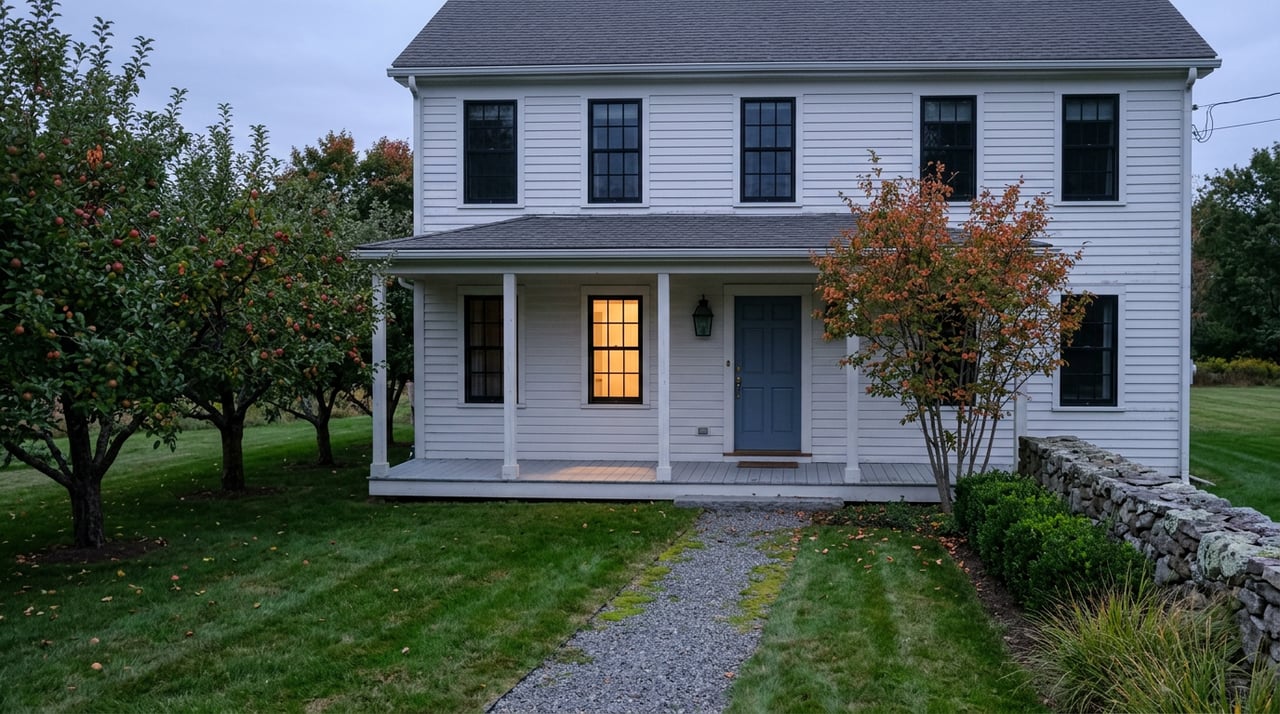
This past June, a crowd of Folsom Elementary students stood on the lawn along Route 2 and watched a 210-year-old building inch north on steel rails. The Old White Meeting House, built by community volunteers in 1816, was being lifted off its crumbling foundation and moved about 100 feet so contractors could dig a new one underneath it. It didn't go anywhere. It just had to leave in order to stay.
That contradiction is the actual story of South Hero this year. Local officials and state lawmakers have been calling this a boom, a pivot, even a renaissance, pointing to new businesses, more tourism, and heavier traffic from Chittenden County. All of that is true. What's missing from the headlines is that almost none of it involved building something new. The town's marquee civic project moved a two-century-old building a few dozen feet. Its newest retail flagship opened inside a storefront that had been empty for years. Its beach improvement plan is about replacing trees with the same species that was already there. If you live here, the shape of this year isn't expansion. It's reoccupation.
A 210-Year-Old Building Finally Went Somewhere
The Old White Meeting House has never really had one job. Since 1816 it has served as a church, a school, and a town meeting hall. From 1999 to 2018 the fire department used the ground floor to park trucks. Since 1954, its second floor has housed Granny's Attic, the volunteer-run benefit shop that donates its proceeds to local nonprofits.
This year's relocation, handled by the timber-framing firm Vermont Heavy Timber, was the first physical step in a restoration that's been in planning since 2018. Selectboard chair David Carter, who has served as the town's liaison on the project, told WCAX after the move that getting through this first phase alone will take up to another year. The eventual plan is to convert the building, its woodshed, and the fields behind it into a year-round community center with space for municipal meetings, the winter farmers market, and school classes. In 2024, South Hero's historic district, with the Meeting House as its major contributing structure, was added to the National Register of Historic Places.
One of the volunteers who has pushed for this restoration for over a decade wrote in 2012 that the building is "South Hero's Norman Rockwell postcard of a quaint Vermont town." That line still shows up on the project's own site, and it's easy to see why. Few buildings in a town this size carry that much use in one structure.
Where the Money for a 1816 Building Actually Comes From
Restoring a building this old is expensive, and the funding trail shows how many separate agencies had to sign off before a single beam moved.
| Funder | Amount | Year Awarded |
|---|---|---|
| Paul Bruhn Historic Revitalization Grant (Preservation Trust of Vermont) | $100,000 | 2022 |
| Vermont Historic Preservation Grant | $20,000 | 2023 |
| Northern Border Regional Commission | $500,000 | 2024 |
| Vermont Housing and Conservation Board (full window restoration) | $100,000 | 2026 |
| State Building Communities / Regional Economic Development Grant Program | $25,000 (requires 1:1 match) | 2026 |
Even with all of that, the town's own accounting on the South Hero Meeting House Project site shows roughly $230,000 still uncovered. The goal is to close that gap through community fundraising and gifts by the end of 2026, so voters aren't asked to cover it through taxes. The nonprofit South Hero Foundation was created specifically to run that fundraising push.
The Newest Business on Route 2 Moved Into Empty Space
If the Meeting House is the town's oldest reuse project, Lake Effect Vermont is its newest. The farmer-owned cannabis market held a ribbon cutting on June 10, 2026, in the McGregor Building at 334 US Route 2, a storefront that had sat vacant for several years on the town's main commercial strip.
Founder Sam Bellavance started the business in 2018 growing hemp on his family's dairy farm in the Champlain Islands. What began as Sunset Lake CBD has grown into three brands, Sunset Lake Cannabis, Sunset Lake CBD, and Lake Effect Vermont, now employing 20 people according to Vermont Business Magazine. The move also relocated the company's e-commerce team out of a rented warehouse in Essex and into the rear of the same building.
The guest list for the ribbon cutting says something about how the town views the project. Sen. Pat Brennan, Reps. Michael and Leeland Morgan, Lt. Gov. candidate Ryan McLaren, and Andy Julow, executive director of the Lake Champlain Islands Economic Development Corporation, all showed up. Julow put it plainly: "South Hero Village is in the middle of a renaissance that has been long overdue." Read literally, what he's describing is a business filling a space that already existed, not a new building going up.
White's Beach Isn't Getting New Amenities, Just the Same Trees Back
South Hero's only public town beach, White's Beach, has a shoreline lined with cottonwood trees that have shaded generations of swimmers. Cottonwoods typically live 60 to 80 years, and according to the South Hero Land Trust, the ones at White's Beach are now showing visible damage and could become a safety risk if left alone.
The fix underway isn't an expansion. It's a like-for-like replacement. Anne Zolotas, the town's tree warden and a selectboard member, has coordinated a group that includes Friends of Northern Lake Champlain, the Grand Isle County Natural Resources Conservation District, and the Land Trust itself, with funding from the Lake Champlain Basin 5 Clean Water Service Provider. The team hired Fitzgerald Environmental Associates, a local engineering firm, to design the replanting plan. As of spring 2026, the project was finishing its public outreach phase before heading back to the selectboard for final approval, with groundbreaking possible as early as this fall.
Nobody is proposing a new dock, a new pavilion, or more parking. The plan is to keep the beach exactly as it functions today, just with trees that can hold the shoreline together for another few decades.
The Harvest Doesn't Care What's Under Construction
While the Meeting House sits on temporary supports and the beach trees wait on a design review, South Hero's orchards are running on a calendar that hasn't changed in generations.
- Allenholm Farm is in its seventh generation of the same family, growing apples on the same 25 acres since Reuben Allen and his son moved to South Hero in 1870. Pick-your-own apple season runs through the fall, alongside the farm's Maple Creemees and farm stand.
- Hackett's Orchard has grown 47 varieties of apples on its South Hero land since 1967, with cider donuts and a farm store open through harvest season.
- September is typically the peak of Vermont's apple season, when varieties like McIntosh, Cortland, and Honeycrisp come in behind the earlier Paula Red and Gravenstein crops from late August.
Even the town's oldest working land use isn't new. It's continuation, the same families farming the same acreage they started on more than a century ago.
What the Boom Headlines Leave Out
Local leaders quoted in the WCAX growth story attribute South Hero's momentum to a tourism spike, more housing to accommodate families, and heavier traffic from Chittenden County. Casey Carton, an islander from North Hero, called it "a complete pivot." Those are real trends. But look at the specific projects driving this year's headlines and the pattern is reuse, not expansion. A 19th-century meeting house moved a hundred feet instead of coming down. A cannabis market took over a storefront instead of clearing new ground. A public beach is getting its shoreline trees replaced in kind instead of redesigned. The orchards keep running on land that's been in the same families since before Vermont had paved roads.
That distinction matters if you live here. It explains why South Hero doesn't feel like it's sprawling even as officials talk about growth. It also tells you something about how the town approaches change. The instinct isn't to build outward. It's to keep repairing and reoccupying what's already standing, whether that's a church, a storefront, or a stand of shoreline trees.
Watch for the Meeting House's first restoration phase to wrap sometime in the next year, the White's Beach tree project to possibly break ground this fall, and the apple harvest to run through October like it always has. None of it is new. All of it is why the town still feels like itself.
If you're weighing what any of this means for property values or timing on the island, Flex Realty works with buyers and sellers across Grand Isle County and the rest of Vermont and New Hampshire. Contact us if you want a local read on what's actually happening in South Hero, not just the headline version.